
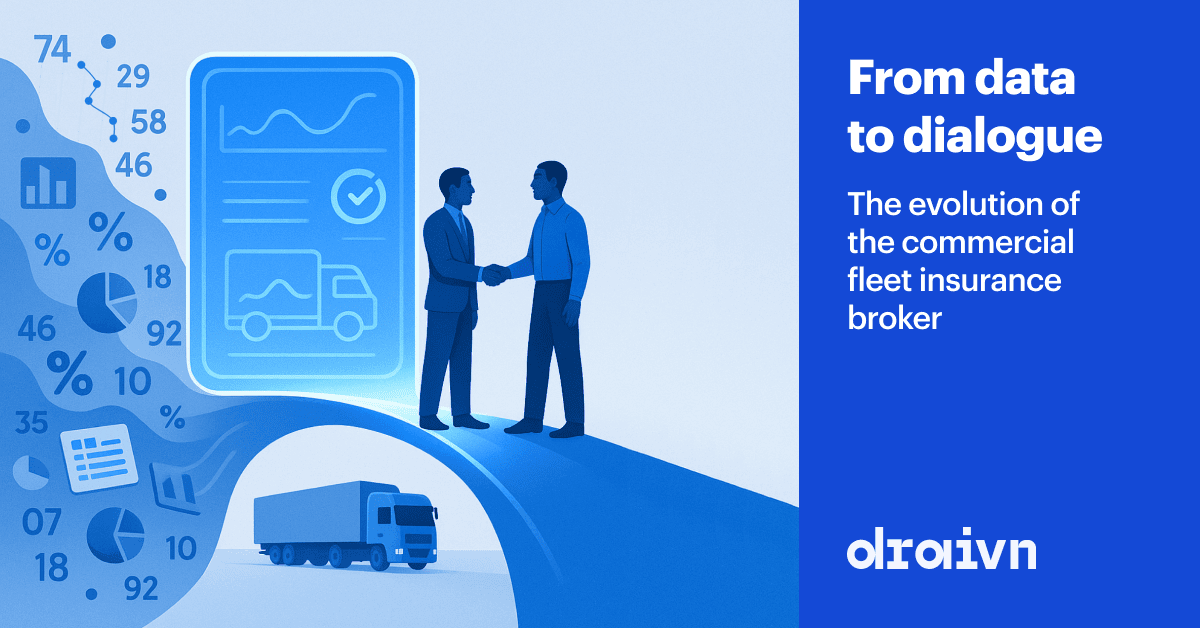
The role of the modern commercial auto insurance broker is transforming. In a market driven by data, but sinking in complexity, success requires more than just putting a piece of business on the books. Today, brokers are expected to act as strategic advisors, educators, and risk partners to their fleet customers.
However, the shift stalls, as data is everywhere, but insights are rare. Transforming information into actionable advice remains a challenge. The answer lies in reimagining the fleet risk profile as a strategic asset.
Good news: brokers are no strangers to fleet profiles when it comes to standard submissions.
Bad news: it’s just the tip of the iceberg.
A fleet risk profile offers insights, creating a foundation for strategic dialogue with customers and redefining broker-client relationships. Let’s take a closer look at how it may work.
What is a fleet risk profile (and why should you care)?
A modern fleet risk profile is not a static, manually compiled document from the past. It’s a dynamic dashboard, offering a 360° view of fleet performance and risk. In other words, it connects how a fleet operates to how it is perceived by insurers.
Being able to see the fleet in the eyes of insurers is good. But more than that, it's a tool brokers can use to translate complex data into clear, strategic insights for their customers.
If fleets could tell their story, they would do it through a fleet risk profile, focusing chapters on:
- Fleet composition:Vehicle age, type, and characteristics, alongside driver age and experience.
- Operational data:Where and how the fleet operates, mileage, urban vs. rural routes, regional risk patterns.
- Behavioral trends: Driving habits, including speedings, night-time driving, and harsh driving events, overlaid with important context: traffic, weather, and road conditions
- Comparative scores and risk benchmarks: How the fleet's safety and risk performance stacks up with frequency and severity benchmarks.
- The average insurer's view:A glimpse at how underwriters are likely to interpret the fleet's data.
Why use it once a year for submissions if you can make it a powerful tool boosting client retention and their risk performance? With your targeted advice and performance tracking, of course.
The four levels of insight: Turning profiles into progress
Let’s break down the insights into four levels that help all players in the ecosystem – brokers, fleets, and insurers – get better insurance outcomes.
1. The macro-view: See the big picture
Before a broker can even start advising, advocating, or placing risks, at least a high-level summary of fleet operations and risks would be useful. An immediate grasp of key parameters – vehicle & driver count, annual mileage, territories, frequency & severity metrics, and recent positive/negative changes – offers an essential baseline for informed conversations.
Previously, gathering even such high-level data could take days, leaving brokers with little time for meaningful, tailored advice for each customer. Modern tools offer brokers this macro-view in minutes, allowing them to anticipate challenges and set the stage for deeper strategic guidance.
2. The insurer’s view: Understand the market perception
Brokers are bridging the gap between a fleet’s operational reality and insurers’ perception. When a client faces a rejection or an unfavorable quote and the question is "Why?", a vague answer undermines trust.
The fleet risk profile provides this explanation backed by data. Brokers can visually show how current fleet data aligns with insurer appetites, objective scoring, and comparative benchmarks. It helps brokers explain underwriting decisions and, more importantly, guide clients toward risk improvements with a clear, actionable, and data-driven plan.
3. The micro-view: Targeted opportunities
Generic advice like "improve driver safety" is functionally useless. A true strategic partner provides actionable recommendations, and a fleet profile enables just this.
It allows brokers to identify which vehicles, behaviors, or drivers create risk, and which improvements will make the biggest difference, for example:
- Focusing a client’s attention on the 10% of drivers responsible for 50% of harsh driving events.
- Advise a client to adjust routes, avoiding high-litigation jurisdiction.
Such advice have real outcomes, like potentially better pricing, reduced claims, and improved insurability. This is how advice can become a tangible asset and another broker’s value proposition.
4. The forward-looking view: From advising to advocating
Traditionally, underwriters make decisions looking in the rear view mirror, where past loss history defines a future risk. Unfortunately, this approach leaves behind the fleets that are actively improving.
Consider a company that has recently overhauled operations, hired a new safety manager, and implemented better controls. The positive changes – being a clear indicator of the fleet's current and future performance – may not be reflected in the loss history, yet.
A modern fleet risk profile allows brokers to demonstrate the most recent improvements to insurers, highlight real progress, and advocate fleets more effectively. In the end, it ensures that fleets aren't penalized today for the mistakes of the past and counterbalances a “rear-view mirror” approach in underwriting.
Who wins?
The adoption of a dynamic fleet risk profile as a tool for strategic advisory and consulting delivers advantages to all players in the insurance ecosystem.
Brokers
- New role:Move from policy submitter & processor to a trusted, strategic advisor.
- High-value clients:Help fleets understand & improve their risk profile and, thus, insurability.
- Customer retention:Win client loyalty with continuous advice on how to shine in the eyes of insurers.
Fleets
- Crystal clarity:See exactly what insurers see and understand what’s behind the decisions and pricing.
- Smarter investments:Invest time and resources where they deliver the highest returns.
- Better insurance outcomes:Minimize rejections and pricing confusion, even in the puzzling commercial fleet insurance market.
Insurers:
- Underwriting confidence:Price and underwrite risks with greater accuracy based on current, validated data.
- Safer industry:As fleets become safer and drivers become more professional, the entire industry benefits from potentially reduced accident rates and fewer legal interventions.
Lead the evolution
The commercial insurance industry demands more than just data, but dialogue, insights, and strategic partnerships. By leveraging dynamic fleet risk profiles, brokers can leave the old model behind and become the data-driven, strategic partners their clients need.
At Draivn, we believe a modern fleet profile can become the core of your advisory strategy. And we have something coming for you.
Let’s move from data to dialogue – contact us to explore how Draivn can help you elevate your role and become the true advisor to your clients. Contact us by messaging here on LinkedIn or at draivn.com.