
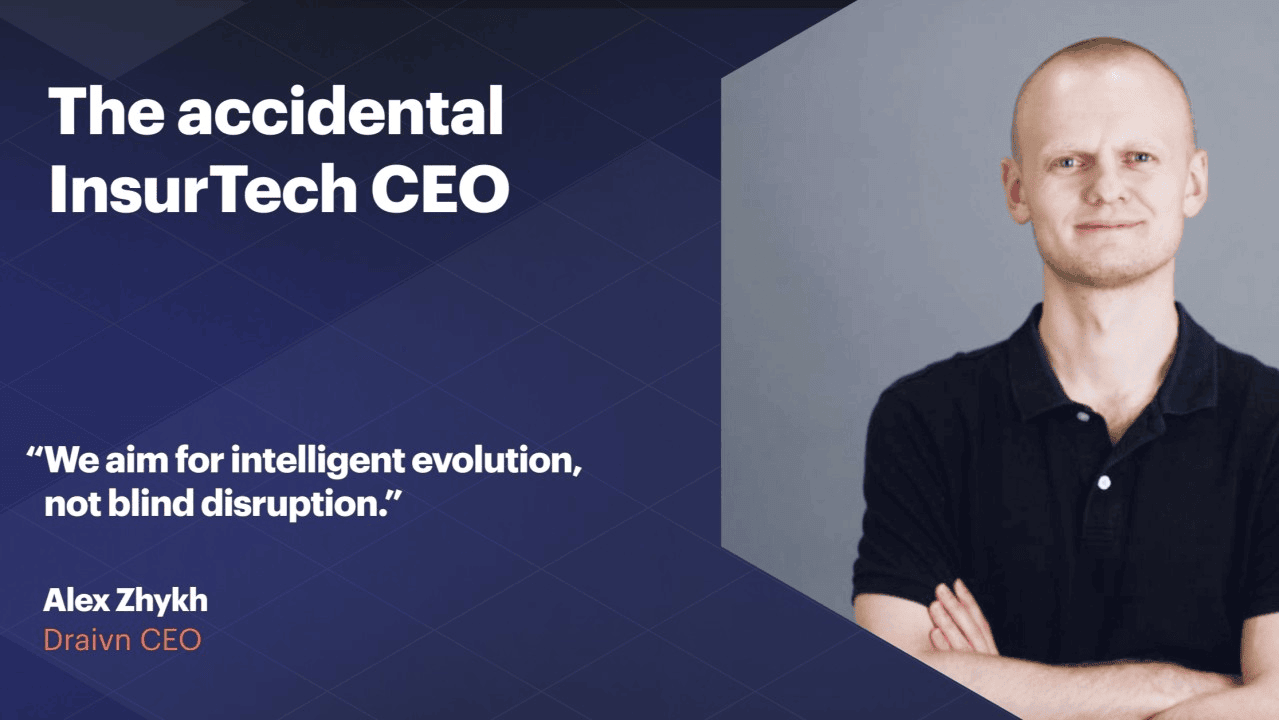
Interviewer: Today we're talking with Alexander Zhykh, Draivn's CEO and “not-your-typical” insurance executive – and that’s exactly the point.
With over a decade in the fast-paced Transportation and Supply Chain sector, founding and successfully exiting startups, he brings a unique outsider's perspective. In this interview, we’ll talk about the benefits of coming from outside the insurance bubble, the broken workflows Draivn is enhancing, and the human impact of making things work better for everyone. Alex, thanks for joining us.
Alex: Thanks for having me.
Interviewer: Alex, you've used the great analogy of being the “startup hoodie” among the traditional “office suits.” How exactly does that outsider perspective give you more freedom?
Alex: I do prefer a hoody, more because of the mindset it represents. Coming from outside the traditional insurance C-suite, I don't feel weighed down by “how things have always been.” There's a freedom in that – a freedom to question legacy processes, to focus purely on efficiency and user experience, and to build something different without the need to protect entrenched systems.
Part 1. An accidental InsurTech CEO
Interviewer: You didn't start your career in insurance. Why do you think “not being from the industry” is your secret weapon?
Alex: Call it a lack of “industry PTSD.” When you haven't spent decades navigating the existing ecosystem, you don't have the ingrained caution or interest in protecting the status quo. My background is in streamlining processes in logistics and tech – finding inefficiencies, using data effectively, and fixing broken processes. I see opportunities for improvement and innovation where others might see immutable complexity or risks of disruption. I don’t want to say I have nothing to lose – I have everything to gain by building something fundamentally better.
Interviewer: Tell us about your background and the moment your outsider's perspective saw a problem differently. Was this the moment that sparked you to co-found Draivn?
Alex: My expertise comes from building systems that work efficiently and intuitively for the user. When I first encountered the commercial auto insurance submission process... It was cumbersome, manual, and felt user-hostile from a modern perspective. It struck me immediately: the fundamental problem with the process design and user experience had a clear solution, requiring digitization and data integration. That's exactly the kind of opportunity my background trained me to spot. Seeing that was the spark for Draivn.
Lucky me, that realization wasn’t mine alone – I had a few opinion allies that quickly recognized the same opportunity from different angles. That shared insight became the spark that led us to found Draivn.
Part 2. Draivn’s superpower
Interviewer: How does your unconventional background influence the company's values and approach compared to more traditional players?
Alex: Our focus from day one was on solving the user's practical problems – whether that user is a broker drowning in paperwork, a fleet manager trying to secure tailored coverage, or an underwriter struggling to evaluate risk with unreliable data.
So yes, we use cutting-edge tech, but those are just the tools. The real innovation, our “superpower” if you say so, lies in how we apply them. It’s about seamlessly integrating data into workflows, radically simplifying processes, and ultimately enabling people within this ecosystem to make faster, smarter decisions based on verified information. It's technology combined with a deep, human-centric understanding of the target workflow, not just tech for tech's sake.
Frankly, none of this would have happened without the incredible Draivn team. Our “superpower” is given by the people behind it, who are consistently willing to go the extra mile, and tackle the complexities, even when the challenges are tough. That dedication is key to turning our vision into reality.
Interviewer: Let's talk complexity. Some argue that telematics-driven insurance is just too complicated. What's your response to that?
Alex: Some focus too much on the inputs. Yes, telematics generates a lot of diverse data, but complexity for complexity's sake helps no one. In our approach, telematics is primarily a powerful tool to verify the information that's needed anyway. For the end-user, whether it's a broker or underwriter, the outputs – like verified vehicle schedules or key rating factors – are fundamentally the same type of information they use today. The crucial difference? It's clean, accurate, and instantly available, not based on outdated spreadsheets or guesswork.
Remember the “garbage in, garbage out” problem that hinders so many data initiatives, especially AI? You can't build reliable predictive models or make sound underwriting decisions on broken, incomplete data. We are focused on fixing that foundational data quality issue.
Part 3. The industry’s pains
Interviewer: Let’s talk about the elephant in the room – inertia. From your perspective, what were the biggest inefficiencies, weirdest norms, or outdated practices in the commercial fleet insurance market when you first entered it?
Alex: We see the immense challenge the industry faces. Making critical, high-stakes decisions with information that's often incomplete, unverified, or based on proxies is a tough position to be in… It may feel like navigating the Cretan Labyrinth blindfolded. You might get lucky and find your way through, but the odds aren't great – even if you are a real hero.
We know that people working inside this system are doing their best with the tools they have. But when combined ratios have stayed above 100% for a decade – even as rates increase – it signals something deeper: underlying data has critical gaps that impact rating, pricing, and claims all the way through.
We’re not here to point to a problem. We’re here to tackle pain points we've experienced firsthand, and we believe there’s a solution, and it’s Draivn.
Part 4. Challenging the norms
Interviewer: What specific industry norm are you most determined to break, and why does it need breaking?
Alex: It boils down to something super simple: convincing the industry to consistently use verified information for critical business decisions. The core norm we're challenging is the acceptance of “good enough” data when verifiable truth is available.
We absolutely understand the hesitation around changing long-standing processes. It's human nature to stick with what's familiar, especially when workflows cultivated over decades involve multiple stakeholders and demanded significant investment in the past.
Our take is – let's acknowledge the real challenges of change, but consider the outcomes. Perhaps it's time we collaboratively explore how new technologies might help the industry take a step forward. All we want is to intelligently facilitate evolution, not force disruption without understanding.
Part 5. Impact beyond profit
Interviewer: Profitability is key, but Draivn aims for a broader impact. What positive changes, and maybe unexpected ones, do you see for the entire commercial fleet insurance ecosystem?
Alex: Beyond the obvious efficiency and profitability gains, there’s a human element. The insurance industry is an important part of the economy, but like many established sectors, it struggles with a talent gap and lag in adopting new technologies. When innovation feels slow or daily tasks are manually-intensive, it naturally makes it harder to draw in “new blood” compared to faster-moving IT sectors.
By streamlining the core workflows, making the work more data-driven and less manually burdensome, we hope to make the sector more dynamic and appealing to the next generation of talent.
Interviewer: How can small changes in the process lead to big wins for everyone involved?
Alex: Sometimes, seemingly insignificant friction points create widespread frustration and risks. Consider data privacy compliance and getting consent to use fleet data. Traditionally, that’s another manual operation, another paper form, another delay, another lawsuit for non-compliance. By digitizing that – making consent fast, electronic, secure, and easily trackable – you eliminate a major bottleneck.
But the impact is broader: you build trust by showing fleets their data is handled professionally and transparently; you relieve brokers & insurers from administrative headaches and give them confidence in compliance. These targeted process improvements have a “domino effect,” fostering better collaboration across the entire ecosystem by removing a small obstacle and making things work the way they should in a digital age.
Part 6. Future Vision
Interviewer: Where does Draivn fit into that future, and what might surprise some industry veterans?
Alex: Looking ahead, the shift towards data-driven risk understanding is undeniable. Fleet’s real-world driving data, safety protocols, and maintenance records – verified by data – are becoming the most potent risk profile indicators. Static, historical data points will become less relevant.
I firmly believe that within the next 5 years, a fleet's verifiable, near real-time operational risk profile will become as critical, if not more critical, than a traditional credit score, significantly influencing insurance costs.
My challenge to the industry is simple: prove me wrong. Why shouldn't demonstrable, data-backed operational safety be the dominant factor? Draivn aims to be the platform enabling such a future.
Part 7. Human touch
Interviewer: Thinking back – maybe not to when you were a “little boy,” but perhaps to an early lesson in your career – what's a piece of wisdom that shapes how you lead Draivn today?"
Alex: Something I learned early on, in complex B2B environments, is that this is fundamentally a relationship-driven business. You may have the most brilliant AI model or the most disruptive ideas & innovations. But if you can't build trust and collaborate effectively with people, if you're difficult to work with, you won't build a truly successful, sustainable company.
Especially when you're trying to drive change, understanding people's pains, finding common ground, and genuinely cooperating with them is crucial. Amidst all the telematics, AI, and data stuff, we have to remember we're dealing with humans, building for humans. Finding ways to collaborate, even when it's challenging, is of the utmost importance. There’s always a path if you're committed to finding it together.
Part 8. Now
Interviewer: If you could give one piece of direct advice to brokers or insurers still hesitant about fully embracing telematics and data integration, what would it be?
Alex: I’d ask them to reflect on the logic of doing the same thing and anticipating a different result. The industry has been struggling with profitability and efficiency challenges for years, using traditional methods. If we keep operating the same way, why would the outcomes suddenly change?
My advice is simple: embrace experimentation. I’d much rather try a new approach and learn from it than stand still and watch the market evolve without me, only to regret not acting sooner.
Especially now, testing data-driven solutions like Draivn Visibility is easier than ever before and risk-free. Moreover, in today's environment, relying solely on outdated manual processes feels like the riskier bet. Playing it safe now might actually mean using the new tools, technologies, and approaches. I say “go for it,” and we will accompany you on the way.