
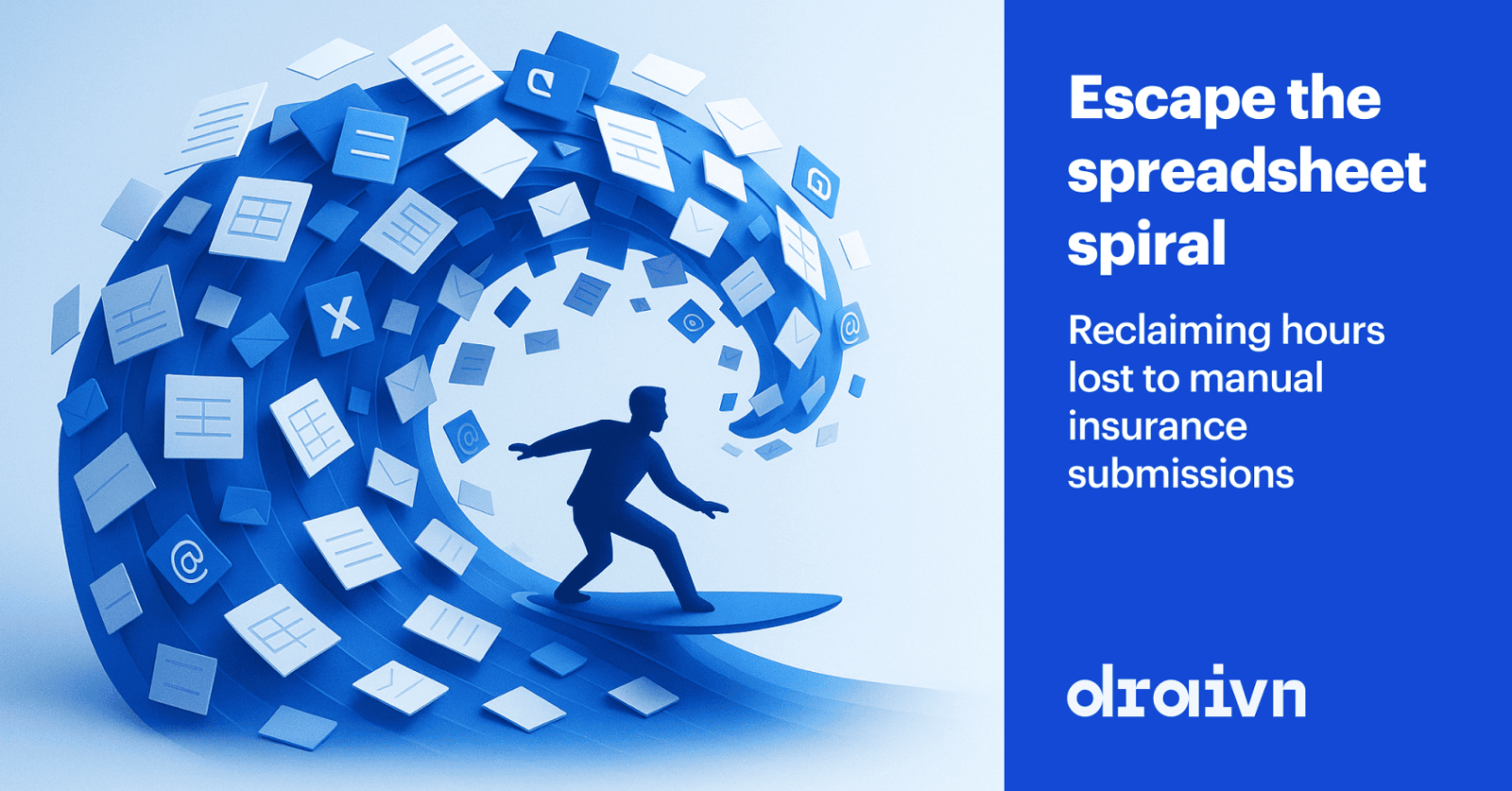
Brokers, insurers, and fleet managers know the drill – as submission and renewal dates are closing in, everyone gets pulled into the spreadsheet spiral:
- Brokers request schedules from their fleet clients in Excel or tables alike (thank God, not paper forms).
- Clients dig through records across multiple systems and departments to complete them.
- The data is emailed back and forth.
- The brokers retype the same details into three different insurer portals.
- Insurers respond: “Missing mileage, VINs, whatever… can you clarify this driver?”
It’s a frustrating, error-prone, and time-consuming process.
Good news: You are not alone here.
Bad news: It’s a systemic industry problem, so you are going down the spreadsheet spiral with others.
The spreadsheet spiral: Downward motion
Some say the problem is written in the industry’s DNA. And if that’s true, ours looks less like a double helix and more like a mutated spiral with four twisted strands:
- Manual data compilation: Vehicle schedules, driver lists, mileage logs, and other data points are often compiled manually. Even in 2025, brokers and fleet managers still spend hours updating Excel files, and none of these files look similar – every new unit or change means more manual input.
- Data reconciliation:Telematics systems, driver reports, and maintenance records are diverse and often conflicting sources. Brokers are left guessing which information is most accurate, correct, and up-to-date.
- Repetitive form-filling:Insurers require pretty similar information, but in different formats. So brokers copy-paste data into multiple application forms, introducing inconsistencies, errors, and losing time.
- The Email vortex: Tedious back-and-forth communication to verify VINs, driver details, mileage data, and other pieces of information. And this loop of emails keeps the spiral spinning.
This isn’t just the industry’s DNA – it’s a mutation and it needs intervention.
Quantifying the administrative burden
Before intervening, let’s talk numbers.
Commercial fleet insurance is not a hobby, where you spend 500 hours constructing a giant whole-basement LEGO city and feel an enormous sense of accomplishment from the finished masterpiece. When you spend 500 hours buried in spreadsheets for insurance, the result is the opposite – your business, your masterpiece, might already be floundering.
Consider this: a broker may spend 8-10 hours on administrative data tasks – compiling, verifying, and submitting data – for just one small fleet submission. With a portfolio of 50 clients, that’s 400–500 hours a year lost to data entry alone, instead of advising clients, optimizing workflows, and growing business.
Manual data handling is not just inconvenient, it’s expensive. Imagine what you would achieve if you freed up those hours.
The solution: Introducing EZ Quote
Draivn Visibility’s EZ Quote directly addresses the pain points of the spreadsheet spiral by automating data collection and streamlining the submission process. This is how it works:
- Fleet managers can start sharing data from their telematics systems with brokers and insurers via Draivn Visibility. It takes just three simple steps – no long implementation cycles required.
- Our platform pulls, validates, and structures real-time data from one or multiple sources, eliminating the need for manual entry, copying, and spreadsheet wrangling.
- EZ Quote generates underwriter-ready, standardized submissions that can be securely shared with multiple insurers.
- Insurers work with complete and accurate data that aligns with underwriters’ expectations, eliminating the need for back-and-forth communication.
In the end, EZ Quote ensures that everyone works with the same, accurate information in a single, intuitive interface.
Breaking the cycle
EZ Quote helps you escape the spreadsheet spiral, potentially giving back those ≈500 hours. This means:
- Brokers become strategic advisors, not data administrators,building client relationships and offering expert advice.
- Fleets become efficient operators, not data collectors,focused on managing operations and increasing profits.
- Insurers become insight-driven underwriters, not data interrogators,offering faster, more accurate quotes.
Reclaim your hours
It's time to escape the spreadsheet spiral and leave manual submissions in the past. Request a demo at draivn.com and see what quoting can look like when you do it the smart way.